gdocs-mcp
Lets an AI agent treat a Google Doc like a local file.
$ npm install -g @dasasian/gdocs-mcp
Then a one-time Google Cloud OAuth client of your own — which is what keeps the credentials yours.
MIT · 0.6.0 · also on npm and the MCP registry
Why it exists
Google Docs is where writing goes to be reviewed. Not written — that happens in an editor, in a repo, wherever the work actually lives — but reviewed, by people who are never going to install anything and should not have to. So anything an agent does to help with real writing has to reach into a Google Doc eventually.
Most of the servers that do this treat a document as flat text: pull the whole string down, push a new string back. That holds up until the document has something in it. Tracked changes disappear. Comment threads are orphaned. Edits are addressed by integer index into a structure that shifts underneath you the moment you write to it.
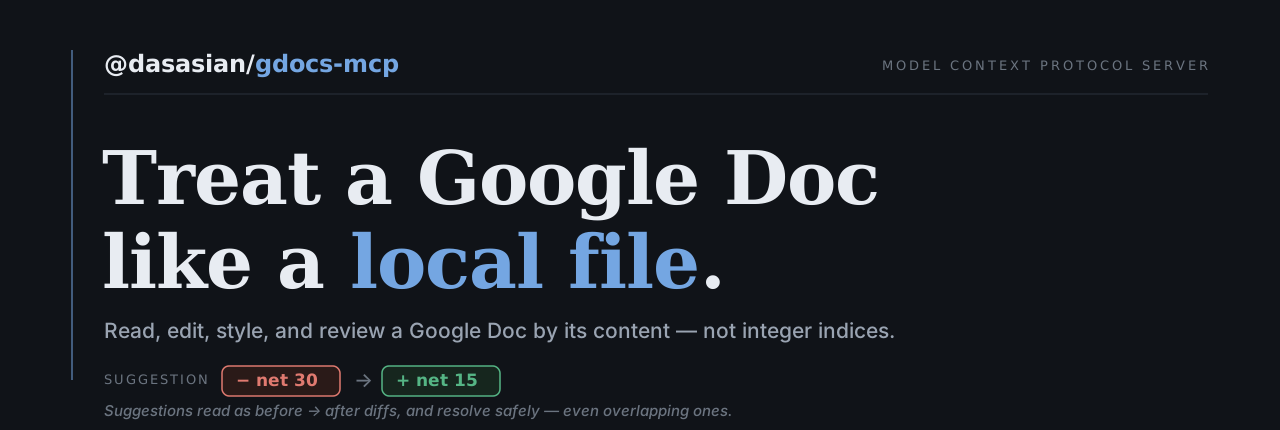
This one is built on the assumption that an agent already knows how to edit: find a unique snippet of text and rewrite it, the way editing a local file works. Indices are never exposed at all. And the part that makes review genuinely possible — pending suggestions read as before → after diffs, accepted or rejected cleanly, including the overlapping clusters that have to resolve together or not at all.
The more useful half is what it admits it cannot do. Google’s API has no way to write in suggestion mode, so every edit the server makes is direct and live, and the tools that write say so rather than letting you find out. Every limitation is documented as the API constraint it is, with the workaround next to it. A tool that hides its edges has not removed the surprise, only moved it somewhere later and more expensive.
It also stops where it should. Wiring chapter files up to document tabs, walking a review, merging the result — that is the job this was built for, and it is deliberately not a feature. The server ships primitives; the agent composes them.
Under it
- Built with
- TypeScript in strict mode, the Model Context Protocol SDK, and Google’s Docs and Drive APIs. Node 18+.
- Surface
- About thirty tools: reading and editing, styling and page setup, suggestions, comments, tables and images, tabs, sharing, and Drive navigation as a filesystem.
- Reading
- What comes back is what is in the document. Colour, size, font and image dimensions read as inline HTML alongside the markdown, so a styling change shows up on the next read and survives being written back.
- Editing
- Text is located by a unique snippet rather than an index, so an edit reads like a local file edit and survives the document shifting under it.
- Accounts
- You bring your own Google Cloud OAuth client, so the credentials stay yours and there is no app to get verified. Several accounts can be authorized at once and a project picks its default.
- Status
- Published, and listed in the MCP registry. The full tool surface is implemented and checked against the live API; markdown code blocks are the one block type still to render.
- License
- MIT
More open source
- firebase-mcp-server
- A schema-aware view of Firebase, for an agent.
- firebase-structured-logger
- Browser errors, symbolicated and structured.