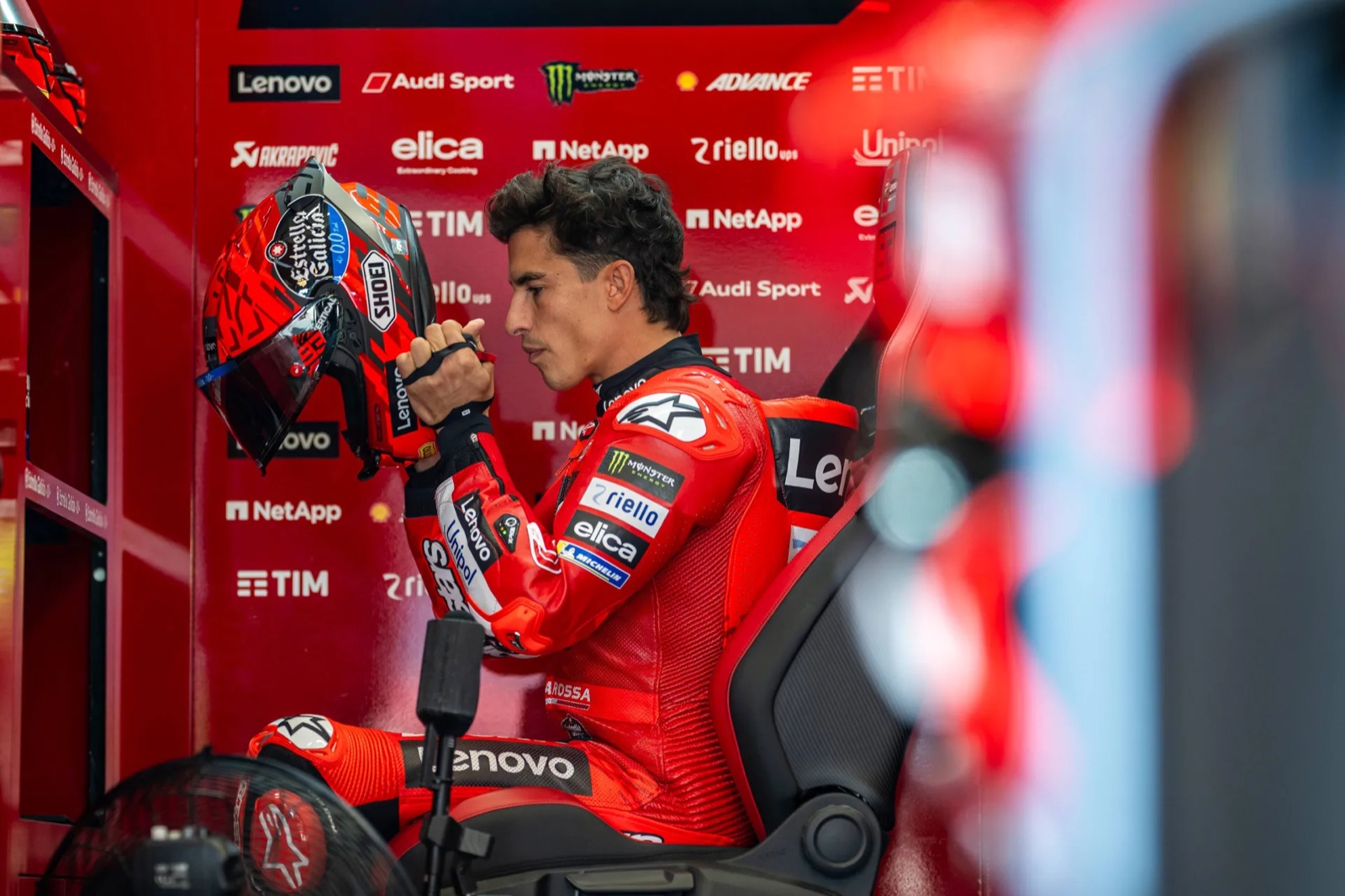
Marc Márquez, Ducati Lenovo Team
“Dress me slowly, I’m in a hurry.” I was reading an interview that Marc Márquez gave. He races in MotoGP, think Formula 1 but on two wheels. He was talking about how he approaches a race weekend, building through practice sessions, not rushing for a fast lap time on the first day. Something about the way he said it stuck with me. Not just the idea. The phrasing. Playful, contradictory, almost musical.
“Vísteme despacio, que tengo prisa.” That’s the original. Spanish. It’s been attributed to Napoleon, to Ferdinand VII of Spain, possibly to Charles III. Some trace it further back, to the Roman emperor Augustus, who said “festina lente,” hurry slowly. The US Navy SEALs have their own version. “Slow is smooth, smooth is fast.”
The same idea, resurfacing across centuries and cultures. Military leaders, emperors, elite soldiers, a motorcycle racer. All arriving at the same place.
Why does it keep needing to be restated? Not because we forget it. We know it. But knowing something and living it are different things. It’s easy to take the shortcut. The reasons change, but the pattern doesn’t. We’re not losing the wisdom. We’re overriding it.
We’re not losing the wisdom. We’re overriding it.
I love Marc Márquez. He won his first MotoGP championship as a rookie and has won eight world championships so far. He’s famous for crashing. Most of them in practice, where he deliberately pushes past the limit to find it. By the time the race comes, he knows exactly where the edge is. It’s structured risk-taking.
But for all that aggression, his approach to a race weekend is surprisingly methodical. He doesn’t go out in the first practice session trying to set the fastest time. He builds. Session by session. Gathering data, making adjustments, learning how the bike is responding to the track and the conditions. Each step informs the next. The speed is there because the foundation was laid properly.
Jerez, Spain. July 2020. Márquez crashed during the race. That happens, that’s the risk they take every time they get on the bike. But this time the bike hit his arm and broke his humerus.
He had surgery. A titanium plate was fitted to the bone. The doctors cleared him to return. He was back on a bike within days.
Days.
He later called it one of the biggest mistakes of his career. The plate was damaged. A second surgery. Then a third, with a bone graft taken from his hip to promote healing. The bone eventually healed, but twisted, his humerus rotated thirty degrees from its normal alignment. A fourth surgery to correct the rotation.
Four surgeries in two years. His career nearly ended.
He knew the wisdom. He practiced it every race weekend, session by session, building methodically to the speed. But he didn’t apply it to his recovery. The man who said “dress me slowly” couldn’t stand to be still. “It was Marc against Marc,” he said later. “One Marc said stop, the other Marc said continue.”
The man who said “dress me slowly” couldn’t stand to be still.
He came back. It took years. He left Honda, the team he’d won six titles with, and joined Gresini in 2024, a satellite Ducati team. Essentially starting over. He used that year to rebuild, to learn the bike, to find himself on it again. The build-up. He earned a factory Ducati seat and in 2025, won the world championship with five races to spare. 2,184 days between titles, the longest drought in the sport’s history.
When he stood on the podium, he cried. “I’m at peace with myself,” he said. “During these last years I was fighting against many, many things, but the most difficult thing was fighting against Marc.”
The wisdom isn’t compartmentalized anymore. It’s not just for race weekends. A week after winning the title, he crashed again at the Indonesian Grand Prix. Fractured his shoulder. The old Marc would have been back on the bike in days. This time he sat out the rest of the season. “Respect the biological timing of the injury,” he said. Even if it meant not racing again that year.
He’s still formidable. Still the same competitive animal. But he rides differently now, smoother, more measured. “Before, I was full risk from FP1 to the race,” he said. “Now I try to control it.” Not tamed. Recalibrated.
I remember following the story as it unfolded. And honestly, I was complicit. I wanted him back at the top as soon as possible.
We all do this. We have the process in one part of our lives and abandon it in another. The methodology that works when things are manageable gets overridden the moment the emotional stakes rise. We tell ourselves that this situation is different, that I can’t afford to slow down right now.
Sometimes it’s the eagerness. The problem is so interesting, so fun, that I want to dive right in. The excitement overrides the patience.
But the bigger pressure is quieter. When the work is happening in our heads or behind the scenes, it’s invisible. Nobody can see the build-up. I remember walking the halls at a company I worked at, thinking through problems, working them out on my own, probably with a smile on my face. My friend Tony told me it looked like I was just loafing. He wasn’t judging, he was saying the quiet part out loud. That’s what it looks like from the outside.
And there’s a real cost to that invisibility. The thinking doesn’t show up on a dashboard. It doesn’t produce something you can point to at the end of the day and say, this is what I did, this is why I’m valuable. So the pressure builds to make the process visible, to produce something demonstrable early and frequently. To prove you’re worth your keep. And when you give in to that, the work becomes performative instead of real. You skip the internal build-up because nobody can see it, and because you’re afraid of what it looks like when they can’t.
It’s never the wisdom we’re missing. It’s the patience to apply it.
Everything around us is designed to go faster. The pace compounds. And with it, the pressure to keep up.
The wisdom is ancient. People have literally bled for it. Márquez carries it in his arm. The rest of us carry it in smaller, quieter ways. In the projects we rushed and had to redo. In the work we pushed through to prove we were doing something. And in the moments where we recognized the pattern and slowed down. Heeding the advice.
Dress me slowly. I’m in a hurry.