Second in a series on building a virtual company. It starts with The Organizational Layer AI Is Missing.
Last time, I ended up creating an org chart without meaning to. One helper to sit between me and the work, and under it others to hand things to. What I didn’t explain was why I thought more agents were better than one agent that could do it all. After all, agents are getting smarter and more capable.
A single agent would build what I asked, and it would be solid. It worked. And when I didn’t care too much about the details, that was fine, I was happy to let it choose, and what it chose looked polished, the stuff I was used to seeing. But the closer I looked, the more it grated. It was focused on building that thing I asked for, filling in the gaps in my description with its knowledge. So it was what I asked for, but not what I truly wanted, and not what I would have built if I did it myself.
Ask a model with no particular instructions to make a call and it hands you the middle ground of everything it has ever read, the safe, balanced, typical answer. The default voice of an AI is the average voice, and the average has no edges. It gives you something reasonable and a little shapeless and weirdly sure of itself, and what it has quietly done underneath the reasonableness is take the decision away from you by blending it. You might even start noticing that when you ask it for options it gives you A, B and C (a hybrid of A & B) and almost always annoyingly recommends C.
The default voice of an AI is the average voice, and the average has no edges.
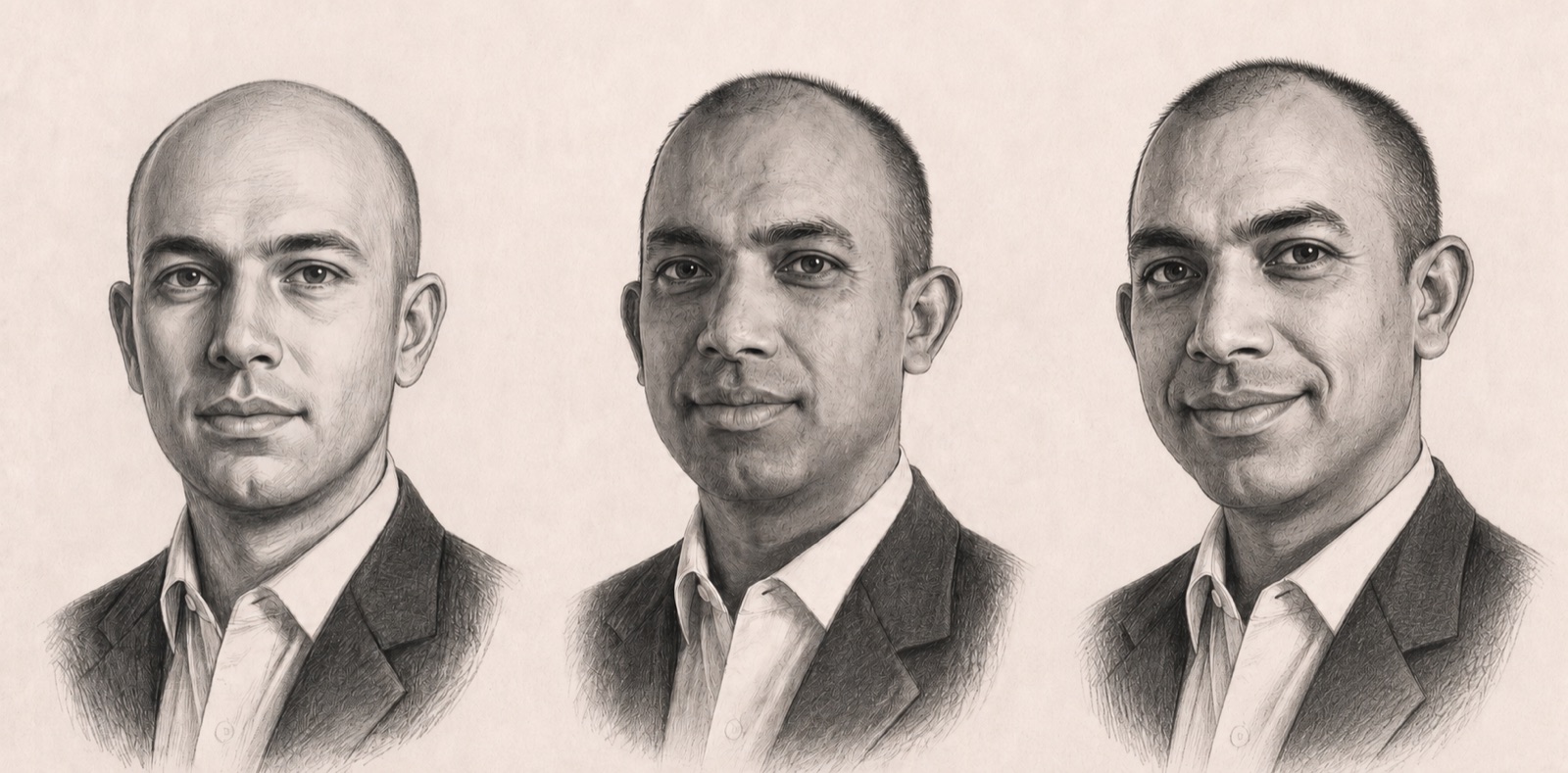
There is a version of this in old photographs. In the 1870s Francis Galton layered portraits of many different faces into a single composite, and the average of all of them came out better looking than any one face that went in. Smoother. More regular. Attractive faces, it turns out, are mostly just average ones. But look closely at one and something is missing. No scar, no crooked tooth, no line that was ever anyone. A face that belongs to no one. That is what the model hands me. The pretty average. The stuff I am used to seeing, and nobody at all.
But a real decision is a fight between all the things you want and the few you can have. Solid and beautiful. Fast and careful. Ship it now and get it right. The averaged answer makes that fight vanish. It splits the difference, calls it balanced, and the one thing I most needed to see, the actual tradeoff, is gone, smoothed flat. What I wanted was not a calmer answer. I wanted back in. The averaged answer had quietly taken me out of it, my judgment and my taste no longer part of the equation. What was being built was generic, not me. The initiating spark was mine. The details weren’t.
So I tried to get the system to expose the edges, the tradeoffs. I gave each thing I cared about its own owner, and I told them to care about their domain almost to the exclusion of the rest. The one who builds it cares only that it is solid, that it stands up, and is untroubled by whether it comes out plain. The one who owns how it looks does not care how hard or easy it is to build. They care that it is beautiful, that it delights the person using it. I was not after balance from any single one of them. I wanted each one biased, on purpose, all the way to the edge of its corner.
I wanted each one biased, on purpose.
And then they would not agree, which was the whole point. The builder: this is solid, it works, send it. The one who owns how it looks: this is ugly, and you have not thought about the person using it. Both of them right. Neither of them the whole picture. But now the thing I had been missing was sitting in the open between them, sharp, impossible to miss. The choice. The exact place where the things I wanted pulled against each other.
They do not decide. They surface. The one I had set in the middle takes their fight and lays it in front of me with the edges still on, and then I choose, this time, for this case, knowing what it costs. Tomorrow, on a different call, I might choose the other way. The system does not hand me the decision made. It hands me the decision visible. The judgment stays mine.
It does not hand me the decision made. It hands me the decision visible.
When I choose instead of letting it choose, the thing that comes out is the opposite of that average face. And there is a whole craft built on that opposite. A caricaturist starts with the same composite of everyone, then does the one thing the machine never does: they subtract it. They take the average away from your face and keep only what is left, the nose a little too long, the gap in the teeth, the eyes set too wide, and they push those the rest of the way. What they draw looks more like you than your own photograph does. They throw away the average and keep the difference, and the difference is the whole of you.
That subtraction is what my judgment is for. The average is what the system offers me. Choosing is how I take it back out, how I keep the edges it would have smoothed away, the details that are the part of me in the thing. Not different for the sake of being different.
What I feel now, looking at a hard call laid out with all its edges still on instead of a smooth answer that already chose for me, is that the decision is more mine than it was when I made it alone. I can see what I am trading. I can feel the weight of it. That is not less work. It is more. It is just the right work.