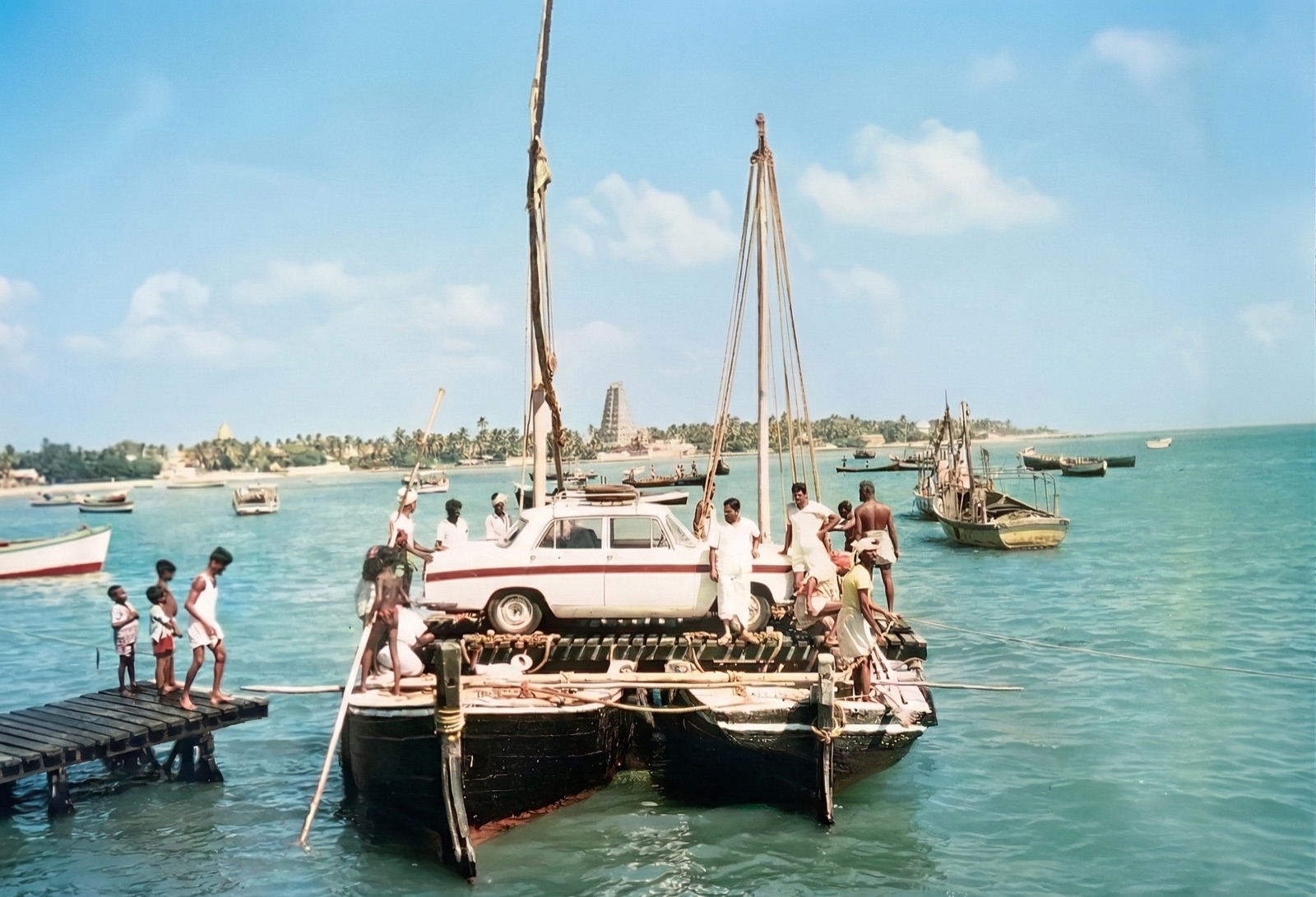
Palk Strait, between India and Sri Lanka. Late 1960s.
Growing up, Indy and Dili’s dad was an almost mythical figure. The picture above is partly the reason. His name is Prasad Wijeweera. When he was a young man in the late 1960s, he went to the UK to study mechanical engineering. He designed car parts, even got offered a job at Boeing in Seattle. He turned it down to go back home to Sri Lanka. He then bought a car for his brother, and he decided to drive it back.
Not to the airport. Across continents. UK to Sri Lanka, by road. Through Europe, through the Middle East, through the subcontinent. Thousands of miles through countries where he didn’t speak the language, across borders that had barely been drawn. No GPS. No route planner. Probably navigating by road signs he couldn’t read and the position of the sun. When the car broke down (and it must have) he fixed it, because that’s what you did. When the road ran out at the water between India and Sri Lanka, he put the car on a wooden catamaran and kept going.
Look at that photo. That’s not something you normally see. That’s someone coming across an obstacle and figuring a path through it.
I’ve been thinking about that a lot lately. Not just about Wijeweera Uncle, but about the people I grew up around. My parents, their friends, people of that generation. There was something about them. An immense self-belief. Not arrogance, something quieter than that. A settled conviction that whatever came, they could handle it. They could figure it out.
Now I’m a father, and I catch myself doing certain things instinctively. Letting my kids struggle a little before stepping in. Giving them context instead of answers. Not filtering what they experience but helping them make sense of it. I do these things without thinking, and this is me trying to understand why.
Watch a child working on a problem. There are so many ways you can help. You can give them the answer. You can walk them through the steps. You can point them in a direction and let them find their way. Or you can sit with them while they wrestle with it and figure it out themselves.
Same destination every time. The answer doesn’t change. But what the child walks away with is completely different.
Give them the answer and they have a fact. Walk them through the steps and they have a method. Let them figure it out and they have something else entirely, the experience of not knowing, sitting with that discomfort, and coming out the other side. They have evidence. Evidence that they can.
Teaching and learning aren’t the same thing. We use the words interchangeably, but they describe different processes. Teaching is something done to you. Learning is something that happens in you. The best teaching creates the conditions for learning, but the two can exist entirely apart. You can be taught without learning. And you can learn without being taught.
Learning is something that happens in you.
The difference matters because of what each one builds. Teaching, done well, transfers knowledge. Learning, especially the kind where you have to work for it, builds something harder to name. It builds the belief that you can figure things out. And that belief changes everything.
I grew up between different worlds. Sri Lanka and Africa as a child, the US later. Different classrooms, different rules, different ideas about what education was for.
Back in Sri Lanka, I failed a math exam because I derived my own steps to the answer instead of following the ones the professor had taught. I understood the theory. I got the right answer. But I’d arrived at it wrong. The method was the point, not the understanding.
I talked to my dad. He agreed with me. I dropped the class and took it with a different professor.
My dad didn’t say “just follow the steps next time”, instead he validated my instinct to understand rather than memorize. It was its own kind of evidence. He created the conditions for me to keep learning my way.
Turns out there’s research that backs this up. When people learn on their own terms, figuring things out, setting their goals, wrestling with the challenge and then overcoming it, they build deeper understanding and more confidence than when they’re just following instructions. And different cultures approach this differently. Some systems prize the group, the method, the standardized path. Others prize the individual, the creative solve, the personal expression. Neither is wrong. But they build different things. And what they build shapes what people believe they’re capable of.
I didn’t have the words for any of this as a child switching between classrooms and languages and countries. I was just dropped into each new situation and had to figure it out. But I think that figuring out (the constant recalibration, the learning without being formally taught) was itself building the thing I’m trying to describe.
There’s a term for it, but it doesn’t quite capture the whole thing. Self-belief. It sounds static, like something we either have or we don’t. But it isn’t a single event. It’s accumulated evidence. Facing something unknown and working through it, small or large, trivial or terrifying, adds a data point. Over time, those data points become a pattern. The pattern becomes a conviction. And the conviction becomes the thing that lets us look at the next unknown and think, “I don’t know how yet, but I’ll figure it out.”
This is what I saw in the people I grew up around. Not people who knew everything, but people who believed, deeply, quietly, that they could work out what they didn’t know. It wasn’t about intelligence. It wasn’t about education. It was something built over a lifetime of figuring things out.
Wijeweera Uncle studied mechanical engineering and designed car parts in the UK. He turned down Boeing to go home. Then he drove a car across continents. And after that he kept going, took apart trains, built toys, ran import/export companies, built multi-story office buildings. None of these things have anything to do with each other. Nobody taught him how to do most of them. He never stopped to ask whether he was qualified. He just figured it out, every time, and moved on to the next thing.
Each one was a data point. Evidence that he could. And each one made the next one more possible.
Did the drive build that self-belief, or reveal what was already there? I think it might be the wrong question. Every experience before the drive made it possible. And the drive itself became evidence for whatever came after. It compounds.
We’re in the middle of something new now. AI can give us the answer to almost anything, instantly. It might be one of the biggest tests we’ve faced. Not because of what it is (a very sophisticated tool) but because of how easy it makes things. Calculators didn’t kill our ability to do math. Computers didn’t either. This isn’t about the tool. It’s about what happens after we get the answer.
If the answer is where we stop, we haven’t built anything. The struggle, the discomfort, the evidence that we can, all of it bypassed. But if the answer is where we start, if we push further, question it, build on it, then getting there faster just means we go further. What we do after the answer is what shapes us.
What we do after the answer is what shapes us.
We all place our belief in something. Religion, science, others, ourselves. AI is just the latest place to put it. And if we put it there instead of in ourselves, we stop building. Not the answers, those come easy now. We stop building ourselves, and that’s the test. Not what AI can do, but what it can turn us into. Greater versions of ourselves. Or lesser ones.
I keep coming back to that photo. The car on the catamaran. The water. The men standing around thinking this guy is crazy. And him, coming up with a solution because he believed he could.
Wijeweera Uncle is in his late eighties now. I don’t know if he thinks about that drive the way I think about it. For him, maybe it was just the obvious thing to do. He had a car to deliver and a home to get back to. And I think he thought it would be a fun adventure.
That’s the part we don’t talk about enough. Self-belief doesn’t just let us take on hard things, it lets us enjoy them. Without it, the same journey is just fear of the unknown. And I think that fear wins more often than it should.
Every time we work through something we don’t know, small or big, a math problem or an ocean crossing, it shapes us, whether we realize it or not.