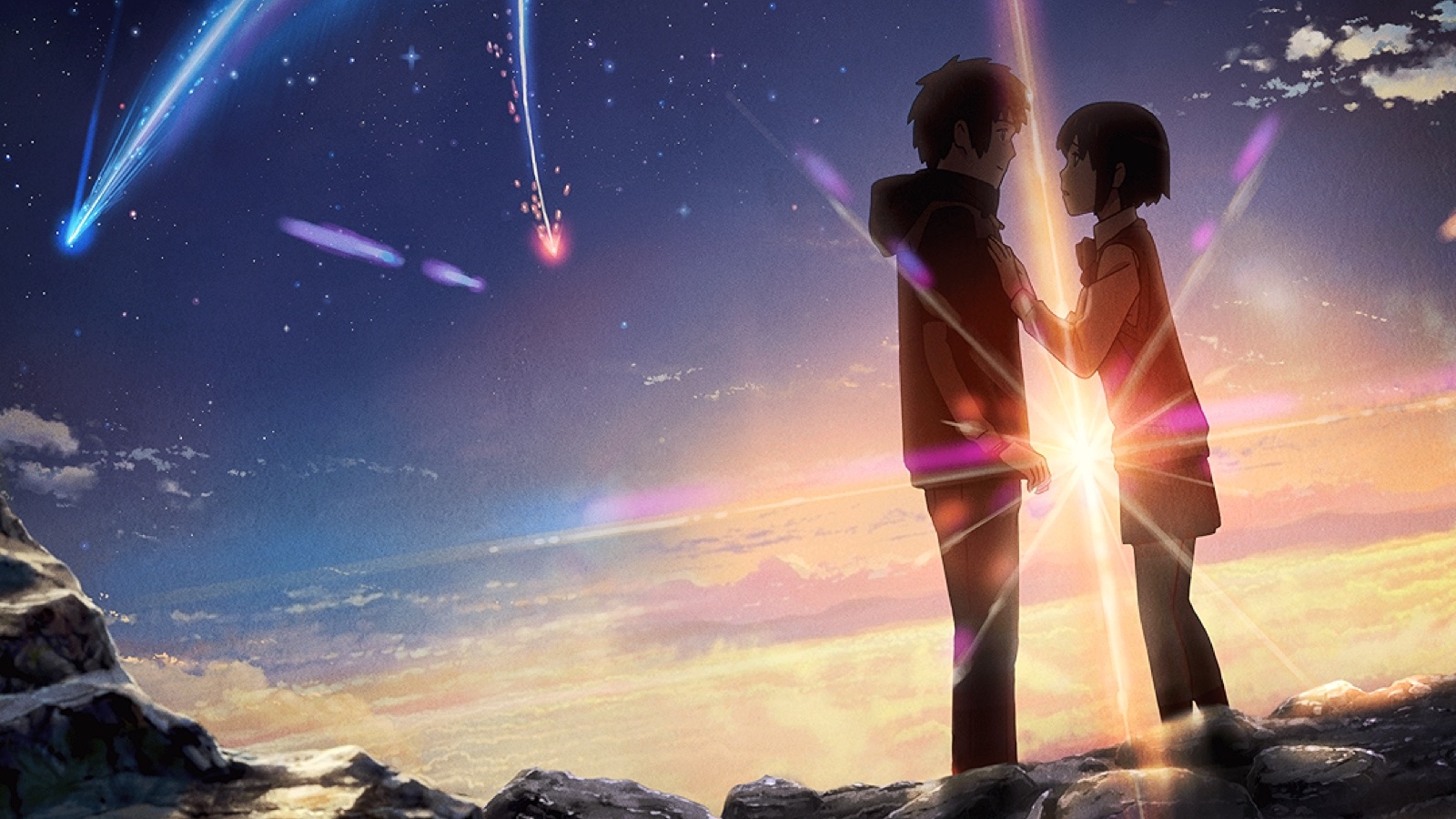
Your Name (Kimi no Na wa), Makoto Shinkai, 2016
Spoiler warning: This article discusses specific plot points from Your Name (Kimi no Na wa, 2016).
I’ve been having vivid dreams lately. I lucid dream sometimes, aware I’m dreaming while I’m in it, and even then I can’t hold on. You wake up and the whole thing is right there, sharp and fully formed, and then it starts to dissolve. You try to hold it. You narrate it to yourself, hoping the words will pin it in place. But the harder you reach the faster it goes. Within minutes you’re left with a mood and a vague sense that something important just happened.
Your Name had been on my list for years. It popped back on my radar when I stumbled across the song “Sparkle” by RADWIMPS on YouTube and kept hitting replay. I don’t understand a word of Japanese. It didn’t matter. Something about the melody, the visuals, pulled at something I couldn’t name. Something just drew me to it. I’ve been noticing that lately, things arriving when I’m ready to experience them in the right way. Or maybe my perception has shifted and I’m just seeing it that way.
The movie was beautiful. It made me want to share what I felt, a connection to something I couldn’t explain, and an urgency to express it before the feeling faded.
For those who haven’t seen it: Your Name (Kimi no Na wa) is a 2016 animated film by Makoto Shinkai. Two teenagers, Taki in Tokyo and Mitsuha in a small rural town, start waking up in each other’s bodies. They don’t understand why. The swaps come and go like dreams, and they can barely remember the details afterward. They leave notes on each other’s phones because they can’t remember what the other did.
That’s the premise, but Shinkai does something out of the ordinary with it. He doesn’t explain. There’s no scientist character who lays out the rules. No mystical guide who says “you have been chosen.” The film trusts you to figure it out alongside the characters, and some of it you never fully figure out. There’s a time gap between them that the film doesn’t announce. There’s a comet. There’s a grandmother who seems to understand everything but speaks only in metaphor.
And there’s the comedy. The refreshing honesty of it. A teenage boy wakes up in the body of a teenage girl and immediately does exactly what you’d expect a teenage boy to do. The film doesn’t pretend otherwise. That honesty is part of what makes it work. By the time it asks you to feel something deeper, it’s already earned your trust by being real about the small things.
The art is extraordinary. Shinkai uses light in a way I haven’t seen in animation. Everything glows. Sunsets bleed through train windows. Lens flares catch on power lines. The whole film feels dreamlike, but not in a hazy way. More like how a dream feels while you’re in it, where everything is impossibly saturated and you don’t question it because it feels right.
You leave the film the way you leave a dream, with the content already starting to blur but the feeling still sharp, still present.
The film got me curious about dreams. What actually happens when we dream? Why do we forget some things while others stay with us?
We’ve all tried to hold a dream. That moment right after waking where it’s still there, complete, detailed, real. And then it isn’t. The edges blur. The faces go. The feeling stays but the content dissolves, like something meant to be experienced but not kept.
Turns out this isn’t a failure of memory. It’s by design.
Researchers have found that our brain actually has neurons (MCH neurons, if you want to look it up) that fire during REM sleep and actively suppress memory formation. The brain isn’t failing to record our dreams. It’s deliberately erasing them. You’re fully conscious in one sense, living through something rich and real, while the machinery that would let you keep it is switched off.
The part of our brain that transfers short-term memory to long-term storage is the last thing to come online when you wake. So there’s this tiny window where the dream is still there, fragile and fading, but the system that could save it hasn’t booted up yet. That’s the window we’re all scrambling in when we reach for a pen or try to narrate the dream to ourselves before it evaporates.
Then I found something fascinating. The emotional residue isn’t just a leftover. It turns out we have two separate memory systems running in parallel. One (the hippocampus) records the facts, the what and when and where. The other (the amygdala) records how it felt. They’re not the same memory at different strengths. They’re different kinds of memory entirely. So when those MCH neurons suppress the hippocampus during dreams, the amygdala does its job and the emotional trace survives.
The brain is actually designed to strip the story and keep the feeling. The forgetting isn’t a failure. It’s a distillation.
Antonio Damasio calls these somatic markers. Emotions stored not just in the brain but in the body. Changes in muscle tone, heart rate, posture, gut. Over time, these body-states become patterns. When you encounter something similar, the body responds before the mind does. The gut feeling isn’t a metaphor. It’s the body remembering what the mind has forgotten.
Which brings me back to the film.
Near the end of the movie, on a mountaintop at twilight, Mitsuha and Taki can finally see each other across the time gap. She asks him to write his name on her hand so she won’t forget. He takes her hand and writes, but we don’t see what. Later when she looks, it says “I love you.”
I’m not sure he wrote that. I think he might have written his name, and it transformed. Because that’s what the film shows us: that facts dissolve but the feeling stays. What it meant doesn’t fade. Maybe the words on her hand were always going to become the feeling underneath them, regardless of what he actually wrote.
Then there’s the ending of Your Name. Five years after the events of the film, Taki and Mitsuha have forgotten everything. Each other’s names, faces, what happened. But they cry when they wake up. There’s an absence they can’t explain, and they spend years searching without knowing what for. When they finally see each other on diverging trains in Tokyo, they feel it. Recognition without memory. They chase each other through the streets and meet on a staircase and ask the only question left: “Your name is…?”
It goes unanswered. The film’s title is an incomplete sentence.
The feeling fills in the gaps. Taki and Mitsuha can’t remember the facts, but their bodies know. The tears on waking. The pull toward each other across a city of millions. The recognition on the staircase. But what is that feeling?
Having grown up in Sri Lanka, Buddhism and eastern spirituality are a large part of who I am. These traditions have always known that feeling is its own kind of knowing. The Buddhist word is vedana, feeling-tone, and it comes from the root vid, which means “to know.” Feeling is knowing. It arises before thought, before perception is even categorized. You feel before you think. Hindu tradition has a beautiful image for this: the heart’s knowing is like the sun, instantaneous and undivided, while the mind’s knowing is like moonlight, sequential and reflected. Even Pascal, from the Western tradition, sensed it: “the heart has its reasons which reason knows nothing of.”
About 150 years ago, feelings became secondary to facts. Dreams became neural housekeeping. The brain defragmenting its hard drive. We mapped the chemistry and called it understood. But what we mapped was the mechanism. We explained how dreams happen. We said nothing about what they are. We explained how emotions fire. We said nothing about what they hold.
I think we lost something in that trade. I’m not saying neuroscience is wrong, the chemistry is real. But mechanism and meaning aren’t the same thing. And I believe there is more to us than what can be measured and quantified. When we collapsed mechanism into meaning we closed a door that cultures across the world kept open for thousands of years.
In our dreams we go to other places, live other lives. We feel connections we can’t explain and glimpse realities our rational minds can’t hold. The facts fade. The plot dissolves, but the feeling stays and it changes us.
I watched Your Name and I’m writing this now because the feelings are already fading. The details are starting to blur, like a dream does. I can feel the article I want to write dissolving even as I try to pin it down with words. Which is, I realize, exactly what the film is about. The scramble to hold something before it goes. The pen in the hand. The name on the palm. The hope that if you just write fast enough, something will stay.
Maybe that’s why I felt the rush. Not just to write about the film, but to catch the feeling before it transforms into something else, before the memory becomes a mood and the mood becomes a vague sense that something mattered.
But I think that’s ok. What matters is that the feeling stays.