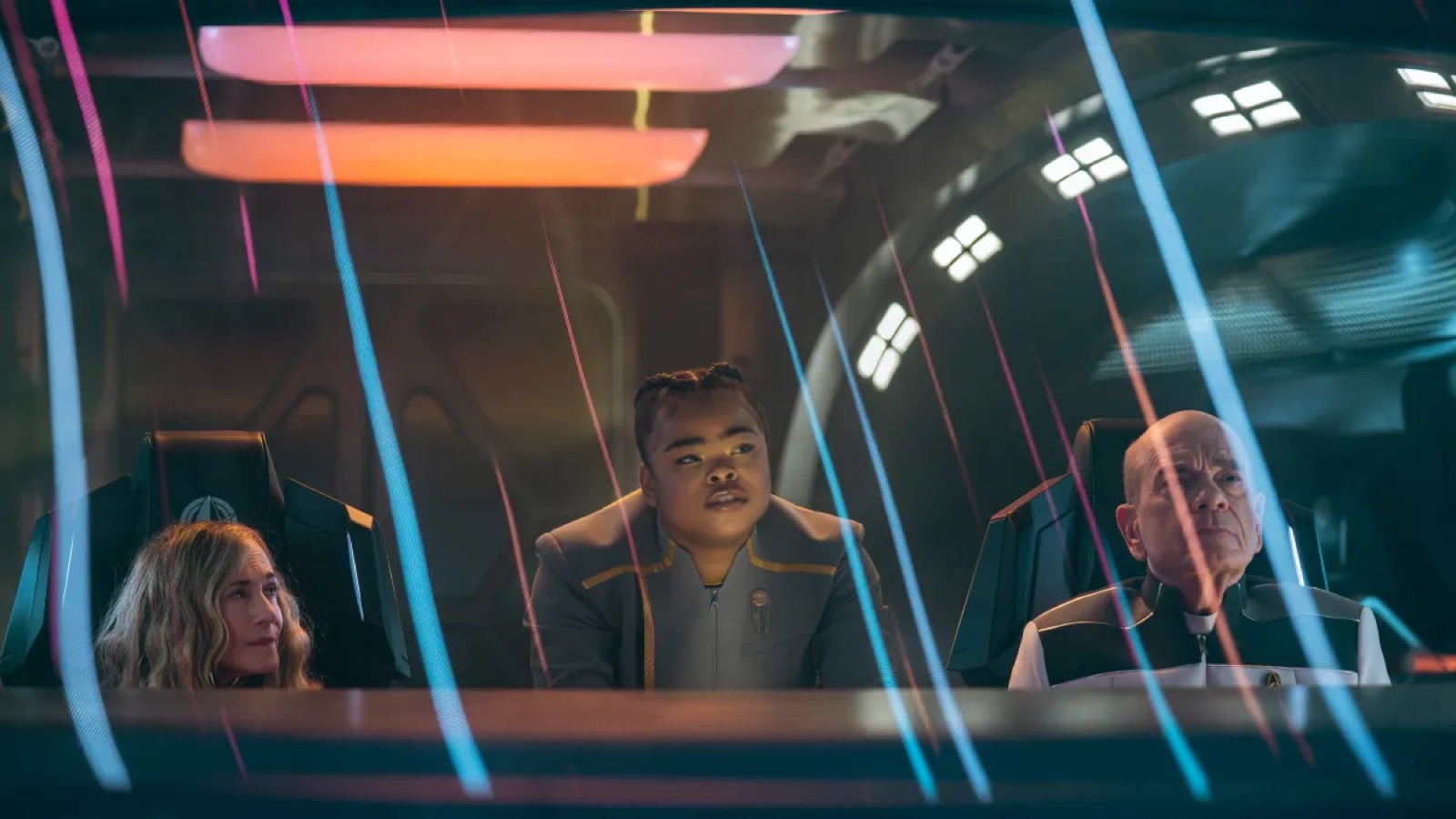
Holly Hunter, Kerrice Brooks and Robert Picardo in Star Trek: Starfleet Academy
Spoiler warning: This article discusses specific plot points from Star Trek: Starfleet Academy Episode 8, “The Life of the Stars.”
This might seem like an article about an episode of Star Trek: Starfleet Academy. It’s actually about how good storytelling got me thinking about trauma, resilience, and how we deal with the things that happen to us.
I wasn’t expecting much from Episode 8. Starfleet Academy has had some ok episodes and some genuinely great ones, but I’d settled into a rhythm with the show, enjoy it for what it is, don’t expect it to stick with me for long. Then “The Life of the Stars” happened and I’m still thinking about it days later.
It starts with two stories, both born from the same tragedy (the deaths during the Miyazaki training exercise) but pulling at different threads.
The cadets aren’t coping. Tilly (Discovery’s Tilly, now a Starfleet instructor) shows up, warm and Tilly-like, with an assignment nobody wanted: deal with your trauma through theater. A 20th-century play, “Our Town” by Thornton Wilder, was chosen, and when you sit with that choice, it’s perfect. It isn’t a comforting piece of theater. Emily dies during childbirth and watches her own life from the afterlife and realizes that the living never appreciate their lives while they’re living them. “It goes so fast,” she says. “We don’t have time to look at one another.” The play doesn’t console. It confronts. It holds up a mirror and says: this is what you’re wasting.
Mary Wiseman, who plays Tilly, and who herself played Emily in a production of “Our Town” when she was at Juilliard, said something in an interview that we should take to heart: “sometimes just presenting with openness or sweetness or kindness doesn’t actually help the person who is suffering.” Tilly’s goal was never to make the cadets feel better. It was to make them feel. There’s a difference, and it’s an important one. The difference between comfort and healing. Comfort says it’s going to be ok. Healing says it already happened, and now you have to live with it, and that living is the point.
Cadet SAM (Series Acclimation Mil, a hologram) is key to the other thread. When she first appeared, I’ll be honest, I thought she was comedic relief. The kind of quirky character that if not done properly would get old really fast. But the writers were way ahead of me. SAM had only been activated a few weeks before the events of the show. Everything was new to her but, unlike a baby, she could articulate it. The writers gave us the gift of seeing through her eyes. So when her programming starts breaking down, it feels like standard Trek stakes: are we going to lose her? Will someone find the fix in time?
But the real issue wasn’t what I expected. And this is where the episode stopped being good and became something that made me think deeply.
SAM’s malfunction isn’t from damage. It’s from absence. She can’t process the trauma of what happened on the Miyazaki because she never had a childhood. She never got the ordinary days: the scraped knees, the small disappointments, the friend who moved away, all the tiny survivals that quietly build the architecture you need to handle the big ones. Her programming can’t cope because she was never given the thing that makes coping possible. Not strength. Not intelligence. Time. Lived, ordinary, unremarkable time.
Not strength. Not intelligence. Time.
It names something we know but don’t think about much: how exposure to trauma can destroy a child mentally. Not because children are weak, but because they haven’t had enough life yet to build the resilience that only comes from having lived. You can’t teach it. You can’t install it. You can only grow it, one ordinary day at a time.
Heady stuff. Trek stuff.
And then there’s the Doctor (an 800-year-old hologram). Until this episode I saw this version of him as someone who had learned to be distant, cold, professional, keeping everyone at arm’s length. His behavior added a whole new dimension to the story. How adults cope in ways that aren’t healthy. That aren’t really dealing.
The Doctor has outlived everyone he’s ever cared about. Every patient. Every friend. Every person who mattered. This isn’t the first time he tried to connect. In Voyager’s “Real Life,” he created a holographic family, tried to have the very thing he later swore off. When it became too painful, he wanted to delete the hard parts. He was told he couldn’t. “That’s not how life works.” Acceptance. Sit with the loss. He took that lesson to heart. Maybe too much to heart. Centuries of it calcified into “don’t love anyone.” A very old wound wearing a professional face.
Then the exchange that reframes that perception. The Doctor says “The only thing that allows me to bear my infinity is not having to love anyone.” And Captain Ake corrects him, gently, precisely. “You mean not having to love anyone again.”
One word. The whole man rewritten. Because “not having to love anyone” is a wall, a decision, an identity you build around the absence. But “not having to love anyone again”? That’s a wound. That’s a history. That’s someone saying I see you, I see that you loved, and I see what losing it did to you. The distance was never about who you are. It was about what you lost.
“Not having to love anyone again”? That’s a wound.
And Ake would know. She’s the counterpoint to the Doctor’s strategy, another long-lived character, but one who holds on. Look at all the trinkets she keeps from her life, how she connects to the people around her. She’s suffered devastating losses, but still holds on. Still reaches for the heat.
So there weren’t two stories. There were three. A child dying because she can’t survive trauma at all. Young adults paralyzed because they’re still building the tools to process it. And an ancient adult who chose to stop living because 800 years of surviving without dealing turned coping into a prison. The juxtaposition of those three stages of the same wound is where the episode finds its depth.
And then Kasq. This is where only Trek can close the loop, and I mean only Trek. The resolution to SAM’s crisis isn’t a software patch. It isn’t therapy. It’s a planet where time moves differently, two weeks equals seventeen years. The Doctor takes SAM there. He raises her. She gets a childhood. Seventeen years of ordinary days, of growing up, of building the resilience that can only come from having been alive long enough to survive small things before the big things arrive. And for the Doctor, seventeen years of loving someone again. A daughter. Healing some of the wounds of his loss through the simple act of being a father. Not because the loss won’t come (it will) but because SAM needs a father and maybe, after 800 years, he needs to be one.
And then all three threads resolve together, and it’s beautifully done. The Kasq montage intercuts with the cadets performing “Our Town,” not because Tilly made them, but because they chose to. SAM growing from infancy through childhood into who she’ll become. The Doctor learning to love again by raising her. And the cadets speaking Wilder’s words about appreciating life while you’re in it, finally facing what they’d been running from. The child gets to live. The young adults choose to feel. The ancient adult chooses to love again. Three wounds, one resolution, woven together while a 20th-century play about the preciousness of ordinary life plays out on a 32nd-century stage.
The child gets to live. The young adults choose to feel. The ancient adult chooses to love again.
No medical drama could do this. No school drama. Only a show with artificial beings and relativistic time and an 800-year-old character can literalize the psychological truth that resilience requires lived time. Only Trek can ask: what if you never had a childhood? And what if there was a world where you could live one?
The franchise itself has grown, like the Doctor, from acceptance in Voyager to transformation here. That’s writers building on what came before, pushing it somewhere new. Forward movement. Gaia Violo, the co-creator and co-writer, on choosing the play: “‘Our Town’ just felt like this perfect, simple, rich story about the human experience and about time.” Noga Landau, the executive producer, knew exactly who to bring back for this and why. These people don’t get enough credit for the work they do. Writers get trashed when they don’t hit the mark, but when something like this comes together, when the craft is so good it becomes invisible, nobody talks about the hands that built it. This episode was built with care, and it shows.
Starfleet Academy has a 4.8 on IMDB. Review-bombed. “Not real Trek.” And I get the impulse, I had similar fears. I don’t want Trek to become style over substance. But as long as it’s telling stories like this one, stories that make me feel, examine, learn and most importantly grow, it’s Trek.
Ake closes out the episode with the words, “Time is both forever and achingly finite. But what a shame it would be not to live every moment.” Words to live by.
Thank you, Star Trek, for reminding me there is more to what makes us.